

Choosing a web development framework can look like a purely technical decision, but it shapes how fast you can launch, how much the application costs to maintain, how easily you can hire or replace developers, and how well the system connects to the tools your business already uses.
The right answer depends less on which technology is fashionable and more on what you are building. A customer portal, a subscription product, and an internal operations tool have different needs, and the frameworks that serve them best are often different too.
This guide explains what web development frameworks are, introduces 10 widely used options for 2026, and gives you a practical way to choose between them for business application development projects.
What Is a Web Development Framework?
A web development framework is a structured set of ready-made components and conventions that developers build on instead of starting from scratch. It handles common needs such as routing, user authentication, database access, and security protections, so the team can focus on what is unique to your business.
Most web applications are built from layers that work together:
• Frontend: what users see and interact with in the browser.
• Backend: the server-side logic, business rules, and user accounts.
• Database: where application data is stored.
• APIs and integrations: how the application exchanges data with other systems, such as payment gateways, CRMs, or ERPs.
Frameworks usually specialize in one or two of these layers. Frontend frameworks shape the user interface. Backend frameworks organize server logic, data, and APIs. Full-stack frameworks cover both, with varying depth.
A note on terminology: not everything in this list is technically a framework. React, for example, is a JavaScript library for building interfaces; it becomes a complete application foundation only when combined with other tools. We include it because that is how it is used in practice and how most people search for it.
10 Popular Web Development Frameworks in 2026
We selected these 10 using three filters: evidence of real-world use, current ecosystem relevance, and suitability for the business applications companies commonly commission. For usage evidence, we used the latest completed Stack Overflow Developer Survey, published in 2025, which covered tens of thousands of developers. It is a self-selected survey of what developers report using, so it indicates developer usage rather than market share, and it is 2025 data rather than a 2026 measurement. We have left out older technologies, such as Backbone.js, that are rarely chosen for new projects.
Where usage is mentioned below, it refers to the 2025 Stack Overflow Developer Survey context described above, not market share.
React (frontend library)
What it is: A JavaScript library from Meta for building interactive user interfaces from reusable components. It was among the most widely reported frontend technologies in the 2025 Stack Overflow Developer Survey.
Where it fits: Dynamic interfaces such as dashboards, admin panels, and single-page applications, where the screen updates frequently without reloading.
Strengths: A very large ecosystem and talent pool, plus flexibility to combine with almost any backend.
Consider: Because React handles only the interface, your team must choose supporting tools for routing, state, and data fetching. Those choices, and how consistently they are made, affect long-term maintainability.
Angular (frontend framework)
What it is: A complete, TypeScript-based frontend framework maintained by Google, with routing, forms, and testing tools built in.
Where it fits: Large, long-lived applications with many screens and multiple developers, such as complex internal systems.
Strengths: Strong conventions keep large codebases consistent as teams grow.
Consider: The learning curve is steeper than Vue or React, and the structure can feel heavy for small projects. Older AngularJS (version 1.x) applications are a different, end-of-life technology, and they usually call for migration planning rather than upgrades.
Vue.js (frontend framework)
What it is: A progressive frontend framework designed to be adopted incrementally, with official tools for routing and state management.
Where it fits: Interactive interfaces on small to mid-sized applications, and adding richer functionality to existing pages without a full rebuild.
Strengths: Approachable syntax and clear documentation make it quick to learn and productive for small teams.
Consider: Its ecosystem and hiring pool are smaller than React’s, which matters if you expect to scale the team.
Next.js (React framework)
What it is: A framework built on React that adds routing, server-side rendering, and static generation, so pages can be prepared on the server before reaching the browser.
Where it fits: Public-facing applications where load speed and search visibility matter, such as marketplaces, content-rich portals, and product sites with app-like behavior.
Strengths: It combines frontend and server-side capabilities in one project, which can simplify delivery for web-first products.
Consider: Its rendering options add architectural decisions, and the framework evolves quickly. Hosting choices can also affect how smoothly some features work.
Express.js (backend framework for Node.js)
What it is: A minimal backend framework for Node.js, the runtime that lets JavaScript run on servers.
Where it fits: APIs and lightweight back ends, especially where a team already works in JavaScript across frontend and backend.
Strengths: Fast to start and highly flexible, with a huge package ecosystem.
Consider: Express deliberately imposes little structure. Security practices, folder organization, and validation depend on the team’s discipline, so larger systems often add a more structured layer on top.
Django (full-stack framework for Python)
What it is: A “batteries-included” Python framework with built-in user management, an administration interface, database tools, and common security protections.
Where it fits: Data-driven applications, internal tools, and content platforms where a working admin panel and clean data modeling matter early.
Strengths: Quick to build structured, secure applications, and it sits naturally alongside Python’s data and AI tooling.
Consider: It follows firm conventions, and highly real-time features need additional components.
FastAPI (API framework for Python)
What it is: A Python framework focused on building fast, well-documented APIs, with automatic interactive documentation generated from the code.
Where it fits: API back ends for web and mobile applications, and service layers for data science or AI features. In the 2025 survey it showed one of the largest year-over-year increases among web frameworks.
Strengths: Modern, efficient, and easy to integrate with Python’s AI and data libraries.
Consider: It is an API framework, not a full-stack one. Admin interfaces, page rendering, and user management typically require additional work or companion tools.
Laravel (full-stack framework for PHP)
What it is: A PHP framework with built-in tools for authentication, database access, background jobs, and scheduled tasks.
Where it fits: Business applications, customer portals, e-commerce back ends, and internal management systems that need to be delivered efficiently.
Strengths: Productive conventions and strong documentation, plus wide PHP hosting availability that keeps infrastructure options flexible.
Consider: Very high-scale or highly specialized systems need careful architecture and performance planning, as with any framework.
Spring Boot (backend framework for Java)
What it is: A Java framework that simplifies building and deploying Spring-based services, with extensive security, data, and integration modules.
Where it fits: Complex, integration-heavy back ends, including financial and large organizational systems where Java is already established.
Strengths: A mature ecosystem, strong support for security and transactional workloads, and a large pool of experienced Java developers.
Consider: Setup and development are generally more involved than lighter frameworks, and it typically suits larger teams and longer projects.
ASP.NET Core (full-stack framework for C#)
What it is: Microsoft’s open-source, cross-platform framework for building web applications and APIs in C#.
Where it fits: Business applications in organizations that use Microsoft technologies, such as Azure, SQL Server, or Microsoft identity services.
Strengths: Strong performance, good tooling, and a predictable release schedule with long-term-support versions.
Consider: It delivers the most value inside Microsoft-oriented stacks. Teams without .NET experience face a learning investment.
Also worth knowing: Svelte, NestJS (a structured framework on Node.js), Ruby on Rails, and Blazor are all credible choices that did not make this list, either because they have narrower adoption among professional developers or because they overlap heavily with options above.
How to Choose the Right Web Development Framework
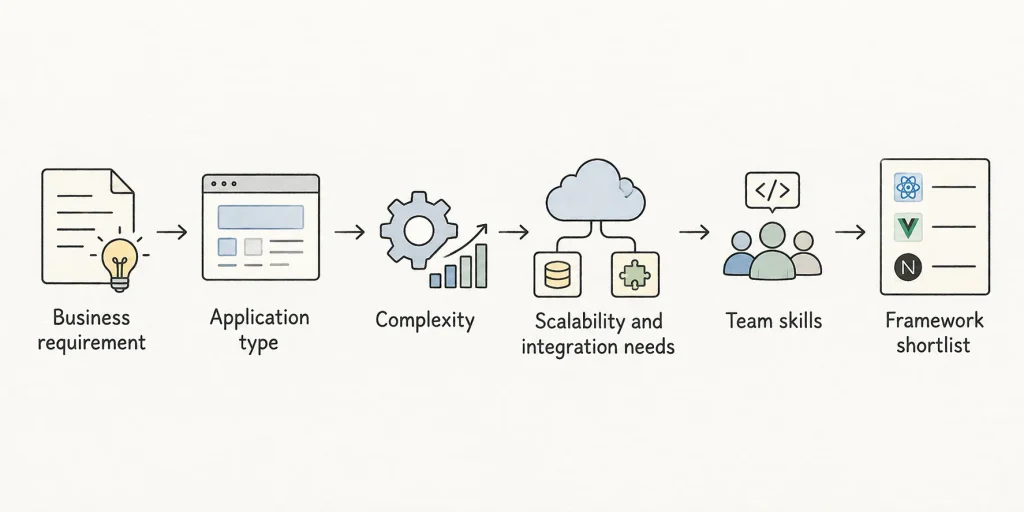
Start with the business requirement, not the technology. Then work through these factors:
• Application type: A public marketplace, an internal approvals tool, and an API for a mobile app have different priorities.
• Frontend vs. backend needs: Decide which layers need new work. You may need only an API, only an interface, or both.
• Project complexity: Many user roles, complex workflows, and heavy reporting favor structured frameworks such as Django, Laravel, Spring Boot, or ASP.NET Core.
• Scalability and performance: Most frameworks scale well when designed properly. What matters is expected traffic, data volume, and where the likely bottlenecks are.
• Security: Look for built-in protections, a track record of timely security updates, and a team that applies them correctly. Framework choice never replaces secure development practice.
• Integration requirements: If the application must connect to ERPs, CRMs, payment systems, or legacy databases, check for mature libraries and a team experienced with those connections. Our Enterprise Integration work typically starts by mapping these dependencies before choosing technology.
• Existing technology stack: Staying close to what your organization already runs lowers hiring, hosting, and support costs. If you are weighing a change because current systems are aging, consider legacy system modernization as a phased approach rather than a full rewrite.
• Team expertise: A framework your developers know well will usually outperform a theoretically better one they must learn.
• Development speed and time to market: Frameworks with built-in components (Django, Laravel) can shorten early delivery. More flexible options give you control but ask for more decisions up front.
• Long-term maintenance: Check the release cycle and support policy. Choose versions with predictable support windows and plan for upgrades.
• Budget.: Account for initial development, hosting, developer rates in your market, and years of upkeep, not just the build.
Which Framework Is Right for Different Types of Applications?
No framework is ideal for every project. These pairings show where each tends to fit; they are starting points to validate against your own requirements.
Business applications and internal systems. Laravel, Django, ASP.NET Core, and Spring Boot are common choices. Laravel and Django are well suited to workflows, approvals, and admin-heavy tools. ASP.NET Core and Spring Boot suit organizations already invested in Microsoft or Java environments. For operational platforms such as business management systems, the deciding factor is usually where your data and integrations already live.
SaaS platforms. A React or Next.js frontend paired with a Node.js, Django, or Laravel backend is a frequent combination. SaaS and subscription platforms add requirements such as multi-tenant data separation, billing, and role management, so back-end structure matters as much as the interface.
Customer portals. Secure login, role-based access, and system integrations dominate here. Laravel, Django, and ASP.NET Core handle these requirements well, often paired with a React or Vue interface. For customer and user portals, the framework matters less than getting authentication and permissions right.
E-commerce and marketplaces. Next.js is well suited to fast, search-friendly storefronts, and Laravel or Node.js often power the back end. E-commerce and marketplace applications typically involve payment, inventory, and catalog integrations, so check the surrounding ecosystem as well as the core framework.
Enterprise and regulated environments. Spring Boot and ASP.NET Core are common where strict security, transactional integrity, and auditability are priorities. In fintech applications, for example, those priorities shape architecture from the start.
Content-driven websites. Where the goal is publishing and search visibility rather than application logic, Next.js or a CMS-based approach is usually more appropriate than a full application framework.
APIs and backend services. FastAPI, Express, Spring Boot, and ASP.NET Core are strong API options. FastAPI is particularly relevant when the service will support AI or data features.
Web Development Framework Comparison
| Framework | Primary Role | Best Suited For | Key Strength | Important Consideration |
|---|---|---|---|---|
| React | Frontend library | Interactive interfaces, dashboards | Huge ecosystem and talent pool | Needs supporting tools chosen deliberately |
| Angular | Frontend framework | Large, long-lived applications | Consistent structure for big teams | Steeper learning curve |
| Vue.js | Frontend framework | Small to mid-sized interactive apps | Easy to learn, quick start | Smaller ecosystem than React |
| Next.js | React framework (full-stack) | SEO-sensitive web apps, marketplaces | Frontend and server features together | Rendering options add complexity |
| Express.js | Backend framework (Node.js) | APIs, lightweight back ends | Flexible and fast to start | Little built-in structure |
| Django | Full-stack framework (Python) | Data-driven apps, internal tools | Built-in admin and security | Strong conventions; real-time needs add-ons |
| FastAPI | API framework (Python) | APIs, AI and data service layers | Fast, auto-documented APIs | Not a full-stack solution |
| Laravel | Full-stack framework (PHP) | Business apps, portals, e-commerce | Productive, feature-rich | High-scale needs careful design |
| Spring Boot | Backend framework (Java) | Complex, integration-heavy systems | Mature, security- and integration-rich | More involved setup |
| ASP.NET Core | Full-stack framework (C#) | Microsoft-oriented business apps | Performance and tooling | Best value inside Microsoft stacks |